Dan Cohen

Archive for the ‘Blogs’ Category

Introducing Anthologize

Monday, August 2nd, 2010

A long-running theme of this blog has been the perceived gulf between new forms of online scholarship—including the genre of the blog itself—and traditional forms such as the book and journal. I’m obviously delighted, then, about the outcome of One Week | One Tool, a week-long institute funded by the National Endowment for the Humanities and run by the Center for History and New Media at George Mason University. As the name suggests, twelve humanities scholars with technical chops hunkered down for one week to produce a digital tool they thought could have an impact in the humanities and beyond.

Today marks the launch of this effort: Anthologize, software that converts the popular open-source WordPress system into a full-fledged book-production platform. Using Anthologize, you can take online content such as blogs, feeds, and images (and soon multimedia), and organize it, edit it, and export it into a variety of modern formats that will work on multiple devices. Have a poetry blog? Anthologize it into a nice-looking ePub ebook and distribute it to iPads the world over. A museum with an RSS feed of the best items from your collection? Anthologize it into a coffee table book. Have a group blog on a historical subject? Anthologize the best pieces quarterly into a print or e-journal, or archive it in TEI. Get all the delicious details on the newly revealed Anthologize website.

Anthologize is free and open source software. Obviously in one week it’s impossible to have feature-complete, polished software. There will be a few rough edges. But it works right now (see below) and it’s just the start of a major effort. The grant from NEH anticipates more work for the One Week team over the next year to refine the tool, culminating in a follow-up meeting at THATCamp 2011.

I suspect there will be many users and uses for Anthologize, and developers can extend the software to work in different environments and for different purposes. I see the tool as part of a wave of “reading 2.0″ software that I’ve come to rely on for packaging online content for long-form consumption and distribution, including the Readability browser plugin and Instapaper. This class of software is particularly important for the humanities, which remains very bookish, but it is broadly applicable. Anthologize is flexible enough to handle different genres of writing and content, opening up new possibilities for scholarly communication. Personally, I plan to use Anthologize to run a journal and to edit and write two upcoming books.

Credit for Anthologize goes to the amazing team that produced it: Jason Casden, Boone Gorges, Kathie Gossett, Scott Hanrath, Effie Kapsalis, Doug Knox, Zachary McCune, Julie Meloni, Patrick Murray-John, Steve Ramsay, Patrick Rashleigh, and Jana Remy. It is notable that the One Weekers ranged from a recent college grad to tenured professors, programmers and designers and interface experts who also are humanities scholars, and professionals from libraries, museums, and instructional technology. Remarkably, they first met last Sunday night and had production-ready code by Saturday morning, a website to market and support the software, an outreach plan, and a vision for the future of the software beyond its original state. Not to mention a logo to go on nice-looking swag (personally, I’ll take the book bag).

Credit also goes to the great Center for History and New Media team that instructed and supported the One Weekers in the ways we like to conceive, design, and build digital humanities tools: Sharon Leon, Jeremy Boggs, Sheila Brennan, Trevor Owens, and many others who dropped in to help out. Two huge final credits: one to Tom Scheinfeldt for conceiving and running the structured madness that was One Week | One Tool, and the National Endowment for the Humanities, which took a big risk on a very untraditional institute. We hope they, and others, like the idea and the execution of Anthologize.

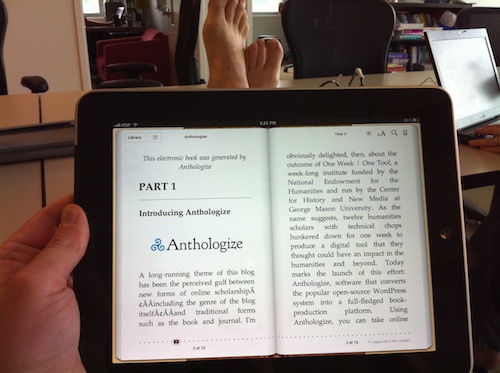
And just to give you some idea of what Anthologize can do, here’s the Anthologize ePub version of this blog post on an iPad, created in five minutes:

Digital Campus #45 – Wave Hello

Wednesday, October 14th, 2009

If you’ve wondered what an academic trying to podcast while on Google Wave might sound like, you need listen no farther than the latest Digital Campus podcast. In addition to an appraisal of Wave, we cover the FTC ruling on bloggers accepting gifts (such as free books from academic presses), the great Kindle-on-campus experiment, and (of course) another update on the Google Books (un)settlement. Joining Tom, Mills, and me is another new irregular, Lisa Spiro. She’s the intelligent one who’s paying attention rather than muttering while watching Google waves go by. [Subscribe to this podcast.]

Leave the Blogging to Us

Friday, December 5th, 2008

The history of genres is filled with curious transformations, such as the novel’s unlikely evolution from wasteland of second-string prose to locus of Great Literature. One of the founding notions of this blog was that despite its inauspicious beginnings and high-profile overcaffeinated incarnations the genre of the blog has always been well suited to the considered pace and output of the scholar.

Original functions of the blog (and the stereotypical blogger), like the transcription of the day’s minutiae or logging of interesting websites (thus the inharmonious neologism, weblog), have, in the last two years, swiftly emigrated to other platforms and genres, such as “microblogging” services like what-I’m-doing-right-now Twitter (with its one-sentence “tweets”) and gee-look-at-me social networks like Facebook. If you’re a trend-seeker, this makes it seem like blogging is passé, abandoned by both the masses and the digerati.

But to me, it’s simply confirmation that the genre has found its most appropriate writers and readers. It reinforces my initial view of the genre, which is that personal content management systems (what blogging platforms really are) are, despite the genre’s early, unpromising forms, perfectly suited for serious thought and scholarship. With blogging, there is no requirement for frequent posting, and I subscribe to many scholarly blogs that have infrequent, but substantive, posts. Put us in the slow blogging camp. As Barbara Ganley puts it: “Blog to reflect, Tweet to connect.”

And while we’re reflecting, it should be rather obvious at this point that thoughtful, well-written blogs can rival other forms of publication. For instance, a baseball statistician and political junkie armed with little more than a free Blogger account and considerable intelligence and energy was able this year to rival the election analysis of most professional newspaper reporters. What are the Chronicle of Higher Education‘s “Brainstorm” blogs than op-ed columns by another name? As I said in the Journal of American History earlier this fall, good writing and analysis rises and makes an impact, no matter the medium or editorial or peer-review system—or lack thereof.

NYPL’s New Blog

Friday, February 22nd, 2008

A few months ago I mentioned a blog from the New York Public Library‘s digital labs. Now the NPYL has launched a superb new overall blog with some terrific images from their collection and some rather humorous and engaging text.

Errol Morris Understands What Academic Blogging Could Be

Tuesday, January 1st, 2008

I’ve been catching up with some reading over break—reading both online and off, despite the NEA’s recent dismissal of the former. And nothing dismisses the NEA’s dismissal of online writing as lesser than print better than the destined-to-be-a-classic series of blog posts by Errol Morris in the New York Times, “Which Came First?” Better written than most novels, more insightful than most academic articles, and more of a (virtual) page-turner than most mysteries, you should do yourself a favor and read the entire series (go ahead, print it out if you must, it’s long), and subscribe to Morris’s blog while you’re at it.

“Which Came First” begins with Morris simply trying to figure out which of two stark and riveting Crimean War photographs by Roger Fenton was taken first—the one with cannonballs strewn across a deserted road or the one with the cannonballs clustered to the side. But the series of blog posts quickly devolves into a discussion and debate about truth in photography and history. Along the way we get pointers about the nature of sunlight, warfare, and Photoshop.

Beyond the series itself, I was impressed by Morris’s conversion to blogging during the writing of the series. (Before “Which Came First?” he only blogged sporadically.) Morris began to realize that open access to his writing online led not only to a large and engaged audience, but also to critical feedback from readers. Some of the reader comments are as shrewd as Morris’s narrative.

I’m at work on a longish series of blog posts of my own tentatively entitled “The Tyranny of the Monograph,” building on my original call for professors to blog. Morris’s conclusion fits with the spirit of my series and with the need to think of new ways of academic publishing in a digital age:

A number of readers have claimed that I am not producing a blog—that I am producing a series of essays. Nomenclature aside, the idea of publishing the responses of readers to a given text (and even to including an author’s responses to those responses) goes back at least to the 17th century…So what is going on here? I believe it should appropriately be called…”Cartesian Blogging.”

Lisa Spiro’s New Blog

Thursday, November 29th, 2007

I’m always looking for good blogs on digital scholarship to add to my feed reader (please email me if you have one and think I may not know about it), and so I was glad to find the thoughtful and well-written new blog from Lisa Spiro, the director of the Digital Media Center at Rice University’s Fondren Library. Lisa’s introduction to her blog:

I plan to explore how digital resources and tools are affecting scholarship in the humanities and consider the potential for digital scholarship. I’ll look at tools and methods, reporting on the ongoing conversation about digital scholarship as well as my own efforts to transform my dissertation on nineteenth-century American bachelorhood from a fairly conventional print-based work to a piece of digital scholarship that makes use of all available tools and resources.

A reCAPTCHA Dilemma?

Monday, October 8th, 2007

Here’s a possible conundrum worthy of the New York Times’s ethicist, Randy Cohen (no relation to your’s truly). I have been a major proponent of reCAPTCHA, the red and yellow box at the bottom of my blog posts that uses words from books scanned by the Internet Archive/Open Content Alliance as a system to prevent comment spam. At the same time visitors decipher the words in that box to add a comment, they help to turn old texts into accurate, useful transcriptions. My glee about killing two birds with one stone has soured a bit after discovering something unsettling: I still get comment spam on my blog, and a lot of it–thousands and thousands of bogus comments.

My investigation of these comments–checking IP addresses, looking at patterns of posting and the links therein, and other discussions of how solid reCAPTCHA’s technology is (e.g., it doesn’t seem susceptible to a “relay attack,” where a puzzle is redirected by the spammer to a unsuspecting person logging onto another site)–leads me to the depressing conclusion that these comments are not done by bots or unwitting third parties. Rather, they are added by hand, one at a time, intentionally. Real human beings are figuring out the blurry words from those old books to insert vaguely plausible comments (“Nice post! Check out my site for more on the same topic.”).

I suppose it’s good news that the spammers are being used as human OCR. By my calculations they’ve decoded, word by word, about 50 pages of text on my blog alone. (Real commenters have transcribed about a half a page.) But I suspect–and would be happy to be proven wrong in real comments, below–that many of the actual people solving the reCAPTCHA are being paid pennies an hour by spam overlords to boost the Google rankings of their clients by adding keyword-rich linked comments to sites with high PageRank.

So in a sense, reCAPTCHA leads to a kind of indirect outsourcing similar to sending a book to be “rekeyed” by low-paid, third-world typists.

Creating a Blog from Scratch, Part 9: The Conclusion

Wednesday, July 25th, 2007

Since its inception until today, this blog was powered by code I had written myself. Some people thought this took a lot of work; to be honest, it was just a few days of simple coding. As I noted at the beginning of this series on “Creating a Blog from Scratch,” rather than using existing software or services, such as WordPress or Blogger, I wanted to write my own blog code so that I could experiment with the form of the blog. In general, I found it to be a great exercise that I would highly recommend. It helped me understand the genre of the blog, challenge long-standing assumptions of form and function (like the tyranny of the calendar, now gone on most blogs), and think about ways one might customize a blog to fit academic needs.

But starting today, this blog will be powered by WordPress, not my own code. Am I a hypocrite? Well, yes and no. Yes, in that by switching to WordPress I have had to abandon some quirks of my original blog that had made it unique and that represented the accumulated wisdom of writing my own code. No, in that I feel I’ve learned enough in the process of the last two years that I can bend WordPress to my will enough to satisfy my need to customize and adapt.

More important, I had other needs that I just didn’t have enough time to implement by writing more of my own code, and there were other features of WordPress–a terrific open-source project–that I really wanted:

  • It took two years, but I’ve decided after initially disparaging comments (sentiments echoed recently by some well-known bloggers), I actually do think they are important to a blog and that my critics were right that the blog suffered without them. So starting today I have comments at the end of each post. (My old posts will remain free of comments since I have left them in their original format.)
  • I had also worried that the blog comments would be a haven for spam, but after the release of the wonderful reCAPTCHA system–which helps the Open Content Alliance transcribe digitized books while preventing spam–I felt that relatively spam-free commenting was possible.
  • As successful open-source software, WordPress has engendered a universe of helpful plugins, modifications, and documentation. For instance, this blog is now Zotero-compatible, thanks to the WordPress COinS plugin by my colleague Sean Takats. And of course reCAPTCHA came with a plugin for WordPress too.
  • WordPress’s system for drafting and editing posts is far more advanced than the basic screens I created. Writing this post is taking me about half the time it would have taken in my old system.
  • For the past six months I have been using ma.gnolia to add small posts to my feed (and to the sidebar of my old blog under “Briefly Noted”). I now can do this just as quickly using WordPress, and plan to post much more frequently starting in September.
  • Despite my best efforts, my old blog code failed to output valid XHTML, which I believe is increasingly important in a world where non-computer devices (such as the iPhone) are browsing the web and RSS feeds. WordPress automatically writes pages in XHTML.

I suppose I should rip off of my sleeve the badge of honor from my home-grown blogging software. But I like to see the switch to WordPress as just another step in the continual improvement of this blog, and look forward to many more years of writing in this space.

PhDinHistory Is Back!

Thursday, July 12th, 2007

Kudos to PhDinHistory for relaunching his blog (at a new address; please refresh your RSS subscriptions). It clearly took a lot of guts and I look forward to many more insightful posts from this vibrant blogger and budding academic. I have no doubt that his site will be the locus for interesting, contentious discussion, and both supporters and critics should applaud his hard work and thoughtfulness.

The Perils of Anonymity

Tuesday, July 10th, 2007

PhDinHistory, we hardly knew ye. A blogger who came out of nowhere to write interesting, thorough analyses of the state of academia and trends in history, captured my attention from the first post and eventually garnered a much wider audience. Then suddenly, this weekend, PhDinHistory deleted his or her WordPress account. No goodbye post and static archive of the blog, but rather a full deletion that made it impossible to read or link to the blog forever. I didn’t always agree with PhDinHistory, but as a blogger who also wanted to write more in-depth pieces rather than quick blogish ones (although more recently I have cheated by adding into my feed smaller posts from ma.gnolia), I truly respected the effort that went into this new blog. From the beginning, however, I thought there was one major problem with PhDinHistory’s blog: its anonymity.

PhDinHistory’s rise and fall demonstrates, I believe, one of the principles I’ve outlined about academic blogging: we shouldn’t use pseudonyms. PhDinHistory may have been a thoughtful blogger, but he or she created a unnecessary distraction by writing under a pseudonym. It might come as a shock to PhDinHistory, but there was almost nothing on his or her blog that was an affront to other students or professors, or that would have been a problem when he or she came on the job market. When PhDinHistory wrote about possible upcoming vacancies in history departments, he or she was simply analyzing the statistics of age and fields of concentration, not proposing to off tenured professors. Besides, professors know that graduate students are constantly mulling over schemes to get dream jobs—we were grad students once, too. It’s actually refreshing to see such speculation out in the open, and with numbers to boot.

Moreover, as I noted in “Professors, Start Your Blogs,” by writing under his or her own name, PhDinHistory would have gained the “responsibility and credit” that goes along with attribution. Both are important. It’s too bad that PhDinHistory will never receive proper credit for months of hard work and many thought-provoking articles. At the same time, I think that the responsibility that goes along with attribution actually would have strengthened, not weakened, PhDinHistory’s blog. I assume PhDinHistory thought that anonymity would be liberating and allow for the fullest latitude on the blog. But writing with attribution would have allowed PhDinHistory to truly join in a conversation with other (non-anonymous) academics. It also would have helpfully tempered some of the more speculative posts. As poets know, total freedom makes for some bad verses.

PhDinHistory thought that there was peril in writing under his or her real name, but it turned out that the opposite was true—it was the pseudonym that was the real peril. All it did—as PhDinHistory admitted to Rob Townsend of the American Historical Association—was to create a contest to see who could unmask the mystery blogger. As the pursuers closed in, PhDinHistory unfortunately had to stop blogging.

The pseudonym was counterproductive, and in PhDinHistory’s case, completely unnecessary. I am undoubtedly not alone in wanting PhDinHistory to return to the blogosphere. The solution to his or her quandary is clear to me, as it is to many others. Simply relaunch the blog under his or her own name and—as hard as this may be—stop worrying. We professors know you don’t really want us to meet an untimely end.