Dan Cohen

Archive for the ‘Conferences and Workshops’ Category

Thoughts on One Week | One Tool

Thursday, August 5th, 2010

Well that just happened. It’s hard to believe that last Sunday twelve scholars and software developers were arriving at the brand-new Mason Inn on our campus and now have created and launched a tool, Anthologize, that created a frenzy on social and mass media.

If you haven’t already done so, you should first read the many excellent reports from those who participated in One Week | One Tool (and watched it from afar). One Week | One Tool was an intense institute sponsored by the National Endowment for the Humanities that strove to convey the Center for History and New Media‘s knowledge about building useful scholarly software. As the name suggests, the participants had to conceive, build, and disseminate their own tool in just one week. To the participants’ tired voices I add a few thoughts from the aftermath.
Less Talk, More Grok

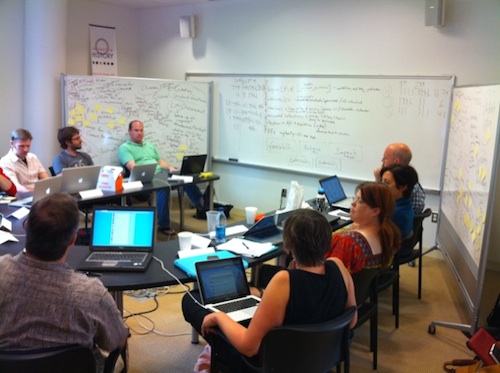
One Week director (and Center for History and New Media managing director) Tom Scheinfeldt and I grew up listening to WAAF in Boston, which had the motto (generally yelled, with reverb) “Less Talk, More Rock!” (This being Boston, it was actually more like “Rahwk!”) For THATCamp I spun that call-to-action into “Less Talk, More Grok!” since it seemed to me that the core of THATCamp is its antagonism toward the deadening lectures and panels of normal academic conferences and its attempt to maximize knowledge transfer with nonhierarchical, highly participatory, hands-on work. THATCamp is exhausting and exhilarating because everyone is engaged and has something to bring to the table.

Not to over-philosophize or over-idealize THATCamp, but for academic doubters I do think the unconference is making an argument about understanding that should be familiar to many humanists: the importance of “tacit knowledge.” For instance, in my field, the history of science, scholars have come to realize in the last few decades that not all of science consists of cerebral equations and concepts that can be taught in a textbook; often science involves techniques and experiential lessons that must be acquired in a hands-on way from someone already capable in that realm.

This is also true for the digital humanities. I joked with emissaries from the National Endowment for the Humanities, which took a huge risk in funding One Week, that our proposal to them was like Jerry Seinfeld’s and George Costanza’s pitch to NBC for a “show about nothing.” I’m sure it was hard for reviewers of our proposal to see its slightly sketchy syllabus. (“You don’t know what will be built ahead of time?!”) But this is the way in which the digital humanities is close to the lab sciences. There can of course be theory and discussion, but there will also have to be a lot of doing if you want to impart full knowledge of the subject. Many times during the week I saw participants and CHNMers convey things to each other—everything from little shortcuts to substantive lessons—that wouldn’t have occurred to us ahead of time, without the team being engaged in actually building something.

MTV Cops

The low point of One Week was undoubtedly my ham-fisted attempt at something of a keynote while the power was out on campus, killing the lights, the internet, and (most seriously) the air conditioning. Following “Less Talk, More Grok,” I never should have done it. But one story I told at the beginning did seem to have modest continuing impact over the week (if frequently as the source of jokes).

Hollywood is famous for great (and laughable) idea pitches—which is why that Seinfeld episode was amusing—but none is perhaps better than Brandon Tartikoff’s brilliantly concise pitch for Miami Vice: “MTV cops.” I’m a firm believer that it’s important to be able to explain a digital tool with something close to the precision of “MTV cops” if you want a significant number of people to use it. Some might object that we academics are smart folks, capable of understanding sophisticated, multivalent tools, but people are busy, and with digital tools there are so many clamoring for attention and each entails a huge commitment (often putting your scholarship into an entirely new system). Scholars, like everyone else, are thus enormously resistant to tools that are hard to grasp. (Case in point: Google Wave.)

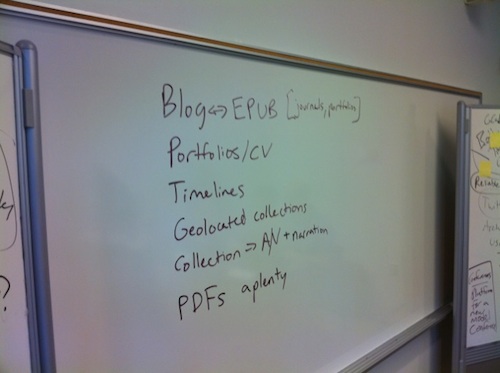
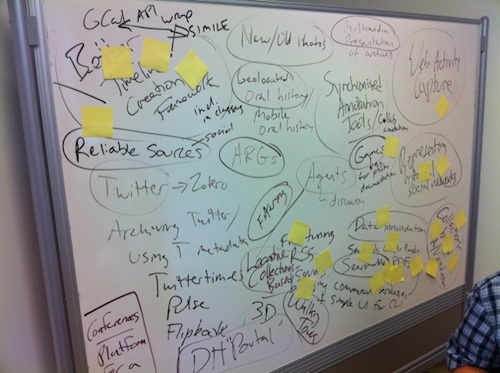
I loved the 24 hours of One Week from Monday afternoon to Tuesday afternoon where the group brainstormed potential tools to build and then narrowed them down to “MTV Cops” soundbites. Of course the tools were going to be more complex than these reductionistic soundbites, but those soundbites gave the process some focus and clarity. It also allowed us to ask Twitter followers to vote on general areas of interest (e.g., “Better timelines”) to gauge the market. We tweeted “Blog->Book” for idea #1, which is what became Anthologize.

And what were most of the headlines on launch day? Some variant on the crystal-clear ReadWriteWeb headline: “Scholars Build Blog-to-eBook Tool in One Week.”
Speed Doesn’t Kill

We’ve gotten occasional flak at the Center for History and New Media for some recent efforts that seem more carnival than Ivory Tower, because they seem to throw out the academic emphasis on considered deliberation. (However, it should be noted that we also do many multi-year, sweat-and-tears, time-consuming projects like the National History Education Clearinghouse, putting online the first fifteen years of American history, and creating software used by millions of people.)

But the experience of events like One Week makes me question whether the academic default to deliberation is truly wise. One Weekers could have sat around for a week, a month, a year, and still I suspect that the tool they decided to build was the best choice, with the greatest potential impact. As programmers in the real world know, it’s much better to have partial, working code than to plan everything out in advance. Just by launching Anthologize in alpha and generating all that excitement, the team opened up tremendous reserves of good will, creativity, and problem-solving from users and outside developers. I saw at least ten great new use cases for Anthologize on Twitter in the first day. How are you supposed to come up with those ideas from internal deliberation or extensive planning?

There was also something special about the 24/7 focus the group achieved. The notion that they had to have a tool in one week (crazy on the face of it) demanded that the participants think about that tool all of the time (even in their sleep, evidently). I’ll bet there was the equivalent of several months worth of thought that went on during One Week, and the time limit meant that participants didn’t have the luxury of overthinking certain choices that were, at the end of the day, either not that important or equally good options. Eric Johnson, observing One Week on Twitter, called this the power of intense “singular worlds” to get things done. Paul Graham has similarly noted the importance of environments that keep one idea foremost in your mind.

There are probably many other areas where focus, limits, and, yes, speed might help us in academia. Dissertations, for instance, often unhealthily drag on as doctoral students unwisely aim for perfection, or feel they have to write 300 pages even though their breakthrough thesis is contained in a single chapter. I wonder if a targeted writing blitz like the successful National Novel Writing Month might be ported to the academy.

Start Small, Dream Big

As dissertations become books through a process of polish and further thought, so should digital tools iterate toward perfection from humble beginnings. I’ve written in this space about the Center for History and New Media’s love of Voltaire’s dictum that “the perfect is the enemy of the good [enough],” and we communicated to One Week attendees that it was fine to start with a tool that was doable in a week. The only caveat was that tool should be conceived with such modularity and flexibility that it could grow into something very powerful. The Anthologize launch reminds me of what I said in this space about Zotero on its launch: it was modest, but it had ambition. It was conceived not just as a reference manager but as an extensible platform for research. The few early negative comments about Anthologize similarly misinterpreted it myopically as a PDF-formatter for blogs. Sure, it will do that, as can other services. But like Zotero (and Omeka) Anthologize is a platform that can be broadly extended and repurposed. Most people thankfully got that—it sparked the imagination of many, even though it’s currently just a rough-around-the-edges alpha.

Congrats again to the whole One Week team. Go get some rest.

Spring 2010 Roy Rosenzweig Forum on Technology and the Humanities: The Library of Congress Twitter Archive

Tuesday, May 18th, 2010

Beth Dulabahn, Director of Integration Management in the Office of Strategic Initiatives at the Library of Congress, will talk about the donation of the Twitter archive to the library. Beth was involved in the talks with Twitter and will provide some background and insight into this major digital acquisition. There will also be a general discussion of the value of the archive and related issues.

The Spring 2010 Rosenzweig Forum will take place Friday, May 21, at 3 pm, in Rm. 470 (the Center for History and New Media’s lab), in the Research I building, George Mason University (Fairfax Campus). Parking is available in the Sandy Creek Parking deck, right across from Research I. CHNM is on the 4th Floor. Directions to GMU: http://www.gmu.edu/resources/welcome/Directions-to-GMU.html

All are welcome to attend!

The Last Digit of Pi – Video of My TEDxNYED Talk and Live Discussion

Thursday, May 6th, 2010

Here’s the video of my talk “The Last Digit of Pi,” given in New York City on March 6, 2010, at TEDxNYED. I’ll be discussing it live on Friday, May 7, at 3p EDT, on Twitter (follow me there or use the hashtag #tedxnyed to join in the discussion).

Regional THATCamps: A Movement

Tuesday, March 23rd, 2010

During this year’s Winter Games in Vancouver, I joked that like the Olympics, THATCamp was a movement, not an event. Well, only semi-joked. I did think there was something to trying to spread widely a new participatory and inclusive academic meeting, one that would spread the digital humanities, encourage collaboration and sharing, and disseminate knowledge better than the standard panels-and-lectures scholarly society annual conference. I’m incredibly delighted that the Andrew W. Mellon Foundation has now generously provided funding to support a network of THATCamps worldwide so that the unconference can serve many more people than we can here at the mothership.

THATCamp: The Humanities and Technology Camp was founded in 2008 by the Center for History and New Media’s Dave Lester, Jeremy Boggs, and Tom Scheinfeldt. (Dave is now the assistant director of the Maryland Institute for Technology in the Humanities.) A strange and wonderful thing happened over the last year: THATCamps started to spring up across the country and beyond, many of them hosted and run by those who participated in the yearly event in Fairfax, VA.

I strongly recommend that readers of this blog read Tom’s full post on the grant and regional THATCamps to get a sense of what’s involved (you can also read my prior posts on THATCamp), and hope that you consider hosting your own THATCamp. You don’t have to wait four years to light the torch.

The Last Digit of Pi

Monday, March 8th, 2010

[This is a rough transcript of my TEDxNYED talk, delivered on March 6, 2010, in New York City at the Collegiate School. TEDxNYED was an all-day conference "examining the role of new media and technology in shaping the future of education." For a meta-post about the experience of giving a TED(x) talk, please read "Academic Theater (Reflections on TED & TEDxNYED)." What I actually said and did at TEDxNYED deviated from this transcript; I engaged the audience directly a couple of times, once for fun and once to get their ideas about the subject. I'll post the video when it's available.]

I want to tell you a story about a forgotten realm of education and knowledge. It is a cautionary tale, a parable of what happens when the world changes, when tradition is challenged.

Until relatively recently in human history, pi was the much sought-after solution to what was long called the “rectification” or “quadrature” of the circle, fancy words more easily symbolized by the diagram in this slide. How can you transform that circle into the overlaid square? One side of the square would be one-quarter of pi if the diameter of the circle is 1.

Pi was a coveted number for thousands of years, imbued with magical properties. Generations of scholars pursued it doggedly, often considering it the be-all and end-all of geometry.

This is a different pi—pi as we moderns know it:

Well, not all of it, as I’m sure you know. It’s just the first 200 or so digits. The number stretches on forever. I hope you weren’t expecting me to reveal the actual last digit of pi. Because there isn’t one. Strange, no?

Pi wasn’t always this strange. The ancient Egyptians knew better, pegging the ratio of the circumference to the diameter of a circle at 4 over 3 to the 4th power. That’s considerably more definite, and thus much more sensible.

Archimedes knew better, homing in on the value of pi between a couple of very close fractions.

If you are a biblical literalist, pi would seem to be 3, since the Bible clearly describes 30 cubits as encompassing a circle of 10 cubit diameter.

And the solutions kept coming. From ancient mathematicians and philosophers, to medieval scholars, to the Renaissance and the Enlightenment. Everyone seemed capable of finding—with enough effort—the exact value for pi. Squaring the circle was an effort of genius in an ancient science perfectly described centuries ago by Euclid.

But something changed radically in the eighteenth century, just after that book on the right by Joubert de la Rue. A few mathematicians started to take more seriously the nagging feeling that pi didn’t have a perfect solution as a magical fraction. It might not have a last digit after all. This critical number at the center of mathematics might, in fact, be irrational. One mathematician began to reconceptualize pi.

And there he is: the dapper Swiss German mathematician Johann Heinrich Lambert:

He was the son of a tailor, obviously, and was mostly self-taught in mathematics. His brilliant work in the 1760s showed that π/4 could not be a rational number—you could never exactly figure out the value of one side of that square—and thus that pi too was irrational. After Lambert, math textbooks declared the matter solved.

That’s right, problem solved…

Except….circle-squaring kept on going. The world of mathematics had changed with the discoveries of the eighteenth century but somehow the message didn’t get through to many people. John Parker, on the left, came up with my personal favorite solution: pi is precisely 20612/6561. Some circle-squarers, like James Smith on the right, mocked Lambert’s proof as the work of a dilettante.

Things then got testy between the new mathematicians and those who clung to the prior vision of pi. The record of this warfare is as informative as it is humorous. In the 1860s and 70s, James Smith took on Augustus De Morgan, a math professor in London, in a series of short pamphlets, which were the Victorian equivalent of Twitter.

But unsurprisingly, the castigations of professors of mathematics didn’t stop the circle-squarers. Their solutions kept on coming, even in the face of criticism, even after pi had been shown to be transcendental, meaning it couldn’t even be the root of some other number or equation. My favorite book from the turn of the twentieth century had this subtitle on the cover: “The great problem which has baffled the greatest philosophers and the brightest minds of ancient and modern times has now been solved by a humble American citizen of the city of Brooklyn.”

Now, it’s easy to laugh at these misguided circle squarers, especially when they’re from Brooklyn. But if you read circle-squarers seriously, and stop to think about it, they are not so different from you or me. Even in our knowing times, we all persist in doing things that others have long since abandoned as absurd or passé.

History tells us that people are, alas, not very good at seeing the new, and instead are very good at maintaining the past at all costs. This is particularly true in education: Euclid’s Elements, written over 2,000 years ago, was still a standard math textbook well into the 19th century, despite major mathematical advances.

So it’s worth pausing to think about the last digit of pi. Why did so many continue to pursue pi as it was traditionally conceived, and why did they resist the new math?

Think for a moment about the distinction between the old and the new pi. The old was perfect, simple, ordered, divine; the new, seemingly imprecise, prosaic, chaotic, human. So the story of pi is the story, and the psychology, of what happens when the complex and new tries to overtake the simple and traditional.

It’s happening all around us in the digital age. We’re replacing what has been perceived as perfect and ordered with the seemingly imprecise and chaotic.

Look at what has happened, for instance, in the last decade with Wikipedia and the angst about the fate of the traditional Encyclopedia.

Or newspapers in the face of new forms of journalism, such as blogging. A former baseball statistician, Nate Silver of FiveThirtyEight.com, can brazenly decide to analyze elections and economy better than most newspapers? Yes indeed.

Now this audience, hip to the right side of these screens, may want to be as mean as Augustus De Morgan to those still on the left. We may want to leave modern circle-squarers behind, and undoubtedly some of them will be left behind. But for the majority who are unsettled and are caught between the old and the new, we need other methods to convince them and to change the status quo. History tells us it’s not enough to say that people are blind to the future. We have to show precisely what the weaknesses of the old are…

…and we have to show how the new works better than the old.

Knowing pi correctly to the 10th digit is enormously helpful when accurately predicting the movements of heavenly bodies; try using James Smith’s 3 1/8 when tracing the arc of a planet or moon. For some physics, knowing pi accurately to the 40th digit is critical.

Moreover, this modern pi may be strange, but its very strangeness opened up new avenues of research and thought that were just as intellectually challenging and rewarding as squaring the circle. The transcendental nature of pi led mathematicians to ponder infinite sequences of fractions and had an impact on chaos theory. In computer science, coming up with algorithms to reach a billion or trillion digits of pi as quickly as possible advanced the field. And, if you still want an unsolved problem to crack, see if you can figure out if pi is what is called a “normal number,” where the distribution of the digits 0-9 is uniform…

…or is there instead a preponderance of eights. Now that’s a tough problem, related to real issues in modern math. So there are still problems to be solved, more advanced problems. Math didn’t end with the end of the old pi—it just moved in new, more interesting directions.

But to get to that point, mathematicians had to show in a comprehensible way how the new pi created a new order.

Academic Theater (Reflections on TED & TEDxNYED)

Monday, March 8th, 2010

This past weekend’s TEDxNYED event in New York took place in the theater of a school just off Broadway. I couldn’t help thinking about the symbolism of that location during the day’s proceedings. TEDx, a spinoff regional program of the billionaires-and-brains edutainment summit in California, TED, pushes speakers like me towards theatrics.

TEDxNYED was enjoyable and I greatly appreciated the opportunity to rub elbows with some digital luminaries and some very smart educators who are doing all the hard work in the trenches while I sit here in the ivory tower blogging. Whatever criticisms may be leveled, TEDxNYED was incredibly well-run and engaging. Before you read my thoughts below, you should first read the wrap-up from Dave Bill, the TEDxNYED “curator,” who gets it exactly right. I’m enormously appreciative of Dave’s hard work and the hard work of his TEDxNYED colleagues.

Back to Broadway: among other things, TEDxNYED gave me a chance to think more about the academic lecture as theater. (It also gave me a welcome chance to summon the vaudevillian genes of my New York Jewish heritage, the effectiveness of which you will be able to assess when the video is posted to the TEDx channel on YouTube in a couple of weeks.)

Take Larry Lessig, the de facto headliner of TEDxNYED. He’s clearly a first-rate legal scholar and influential activist. But after viewing him live, I realized more than ever that he’s also a rather talented performance artist, with crack comedic timing. (Here’s his talk; judge for yourself.)

We professors don’t like to admit it, but comedy and performance are important ingredients in most successful academic lectures, and can spur the pursuit of knowledge and action far better than serious monograph or article. When I was in college nearly everyone interested in history—from any era or place—took Stephen Cohen’s class on Soviet history, mostly because he was entertaining. He even had one lecture consisting entirely of jokes. Sure, it was gimmicky. But I also know several of my classmates who went into careers in diplomacy and history because of the inspiration.

Of course, academic theater can also lead to problems. TED talks are limited to 18 minutes, inevitably leading to reductionism. As I quipped in my talk on the 6,000 year history of π, “Portions have been condensed.” The humanities particularly suffer from this condensation. For instance, as hugely entertaining as Lessig’s talk was, if you watch it I’m sure you’ll pick up that it conflates, quite problematically, two kinds of conservatism: religious conservatism and libertarianism. Just because the Cato Institute can imagine a role for remixes doesn’t mean that those who attend free church potlucks can. Modern conservatism is an extraordinarily complex mix; one need only look at the tension between libertarian and evangelical views of homosexuality. Gina Bianchini, the CEO of Ning, a network of social networks, presented her work as “the joy of connecting optimists from around the world,” leaving out the fact that the history of Ning is far more interesting: it started out as an engine for making web apps, only later turning toward social networking. That’s actually a fascinating, complex business history that I would have liked to hear more about.

TED’s tagline is the catchy “Ideas Worth Spreading.” I’m an intellectual historian and appreciate the emphasis on ideas; as an educator I’m in favor of spreading knowledge. But in my later years I’ve also come to realize that while ideas are important, execution is probably more important. Lessig and Bianchini also know this—Lessig is now working on methods of more effective lobbying and Bianchini is obviously a talented CEO—and it would have helped TEDxNYED if they had explained to the audience the nitty-gritty details of making real change and progress. It doesn’t come from clever sound bites.

The TED spotlight-on-the-stage format also encourages the audience to perceive the speakers as isolated geniuses, coming out to impart wisdom. The host who introduced me credited me as being the solitary creator of several projects and works, all of which were actually broad collaborations. Again, collaboration is more complex than the format allows. Jeff Jarvis decided to blow up the format by getting up on stage with the lights on and ranting about the insanities and inanities of modern education. This was effective in a Lenny Bruce sort of way, but like Bruce, it was the exception that proved the rule that we speakers were bound to a certain form of academic theater. Inspired by Jarvis, I broke the fourth wall and interacted with the audience a couple of times during my talk, but it was perhaps a little superficial.

Regardless of these criticisms—which I give, again, entirely in recognition of the success of the event and with an eye toward improvement for next year—I enjoyed the challenge of doing a TED talk. I’m working on a much more formal Big Lecture at Cambridge University, and TEDxNYED helpfully made me think about the problems with that format as well. Indeed, I’m not blaming TED for the problems of academic theater. I actually believe the fault lies with academics themselves, who have ceded the ground of public intellectualism in the past generation or two, leaving a vacuum that TED and TEDx are happy to fill.

Hopefully—and judging by the tweets and blog posts this is true—the attendees took away more of the advantages than the disadvantages of the format, and will go on from thought to action.

[photo credit: Kevin Jarrett]

TEDxNYED

Friday, March 5th, 2010

This weekend I’ll be one of the speakers at TEDxNYED, a conference examining the role of new media and technology in shaping the future of education. Other speakers include Lawrence Lessig, the Harvard legal scholar who has written on—and more importantly, acted on—the impact of digital technology on copyright; Jay Rosen, NYU journalism professor who is a powerful critic of traditional “savvy” journalism and advocate for decentralized citizen journalism (and who, in my opinion, is the academic currently using Twitter most effectively);  Jeff Jarvis, author of What Would Google Do? and professor at the City University of New York’s Graduate School of Journalism; Gina Bianchini, CEO of the social network app Ning; USC media scholar Henry Jenkins; KSU cultural anthropologist Michael Wesch, who is well-known for making new media comprehensible through sharp videos; and others working in digital education I’ve wanted to meet.

You can watch the proceedings live on the conference website from 10a-6p EST on Saturday, March 6, 2010. I’ll be on at 4:30p. The title of my talk is “The Last Digit of Pi.” (No, there is no last digit of pi. It’s what they call a “teaser.”)

Digital Humanities Sessions at the 2010 AHA Meeting

Tuesday, December 22nd, 2009

Out of hundreds of sessions at the 2010 American Historical Association annual meeting, nine are on digital matters. Nine. I’m on one-third of the sessions. It’s 2010, and academic historians seem to feel that digital media and technology are not worth discussing, and that we can just go on doing what we’ve done, how we’ve done it, for another hundred years. For comparison, the 2009 MLA has three times as many digital humanities panels.

Anyway, the digital sessions (hope to see you there):

Is Google Good for History?

Crossing the Electronic Rubicon: Navigating the Challenges and Opportunities Presented by Archival Records Created and Stored Exclusively in Digital Format

Teaching Sourcing by Bridging Digital Libraries and Electronic Student Assignments

Humanities in the Digital Age, Part 1: Humanities in the Digital Age, Part 1: Digital Poster Session

Humanities in the Digital Age, Part 2: A Hands-On Workshop

Scholarly Publishing and e-Journals

What Becomes of Print in the Digital Age?

Assessing Resources: Analysis and Comment on EDSITEment Lessons in the High School and Undergraduate Classrooms

American Religious Historians Online

THATCamp 2009

Thursday, March 5th, 2009

thatcamp_2009_logo

What was both the most enjoyable and the most productive conference I went to last year? THATCamp: The Humanities and Technology Camp. OK, I’m slightly biased because THATCamp takes place at the Center for History and New Media at George Mason University, but you can get confirmation from last year’s other attendees. THATCamp is the brainchild of CHNM’s Dave Lester, Jeremy Boggs, and Tom Scheinfeldt.

For those new to the concept, THATCamp is an unconference, which means that there are no stodgy panels or fussy exchanges. Instead, the attendees self-organize on the first morning into sessions of interest, and then plunge right into learning from each other. Everyone is a participant, and subgroups often break off to try out new things. It is a very casual but fairly intense two days of conversation, coding, and comraderie. And it’s free. (We do pass around a trucker’s hat for donations to provide coffee and snacks.)

THATCamp 2009 will take place on June 27–28, right after Digital Humanities 2009 at the University of Maryland. You need to apply if you would like to come, and slots are limited, so unfortunately the organizers will have to be selective. We have a larger number of slots this year, but still expect to be oversubscribed, so please put on your application what you would be willing to share with the other attendees.

Also, there are a limited number of sponsorships available to organizations, institutions, and companies. It’s a great way to get the word out about your program or product, so if you’re interested in sponsoring THATCamp, send an email soon to info@thatcamp.org.

Smithsonian 1.1 and 2.9

Tuesday, January 27th, 2009

si_logoI was lucky enough to be invited to the Smithsonian 2.0 meeting this past weekend as one of the “digerati” who were there to prod the institution out of its analog complacency into the digital future. Long-time readers of this blog will probably sense my amusement at the “digerati” designation; not only am I a history professor, which seems like an instant disqualification for any noun that ends in -ati, but I’ve always tempered the Vision Thing with the Pragmatic Thing. Having done a lot of big digital projects, my feeling is that using mod_rewrite well is as important to success as modifying ideals. Edison’s dictum about “1% inspiration and 99% perspiration” remains true for the digital realm.

Anyway, the real digerati showed up at Smithsonian 2.0 too, and they did indeed provide inspiration: hip representatives of Facebook and MySpace, people with “seriously, that’s your title?” titles like Chief Gaming Officer, and bestselling authors like Chris Anderson, editor of Wired magazine and Long Tail theorist, and Clay Shirky of Here Comes Everybody fame. (Long-time readers of this blog will probably sense my envy at not having a cool, bestselling book like these ones.) It was an incredibly well-run meeting; several of the attendees joked that the Smithsonian could get to 2.0 just by placing the people who deftly managed the coat racks in charge of the web servers.

If you really want to get a full feeling for the meeting, the best way to do it (in true 2.0 style) is to read in chronological order the Twitter stream of it. I jotted a lot of notes and ideas there, as did many other attendees. (You can follow me on Twitter @dancohen.) In addition, via the power of Twitter, we captured many excellent points and responses from people around the globe. You should also be sure to read the discussion page on the main Smithsonian 2.0 site, and initial crowdsourced recommendations I gathered before the meeting.

Let me summarize my post-meeting sense of where the Smithsonian should go for those who don’t have time to read a hundred tweets. Given my background in mathematics, I began to think of Smithsonian 2.0 as existing between Smithsonian 1.1 and Smithsonian 2.9. That is, implicit in “Smithsonian 2.0″ were some incremental moves forward that could be done cheaply and quickly—Smithsonian 1.1—and a very large, expensive, complex project that would lead Smithsonian into Web 2.0 and beyond—Smithsonian 2.9. I believe both of these models can be instructive to institutions beyond the Smithsonian, whether large or small.

Smithsonian 1.1 would involve a much more aggressive use of social media and technology that’s already out there, to begin to take many small steps and make many small experiments using what is currently available. The Smithsonian has already done some of this, of course: the National Museum of American History has a blog, SI has a small presence on Flickr Commons, and museums have begun to tweet.

But these are relatively scattered, uncoordinated attempts, frequently done by younger, tech-savvy SI staffers in their spare time. The Smithsonian should be doing much, much more of this. For instance, given their expertise and excitement about SI’s holdings, it seemed clear to the digerati that every curator should have a blog, even if infrequently used, to recount tales of objects. While visiting the Museum of American History’s vaults, it was clear that a huge audience would subscribe to a weekly or daily video podcast that covered incredible treasures that rarely see the light of day, such as Abraham Lincoln’s handball, or what the Smithsonian just collected and is preserving from the inauguration of Barack Obama.

lincoln_handball

obama_ephemera

Undoubtedly there will be resistance among some curators to doing Web 2.0-y things like podcasts or crowdsourced tagging of their items. These curators believe that such efforts belittle (or “anti-intellectualize,” as one put it) the holdings of the Smithsonian. (As Chris Anderson tweeted: “Response from curators to my Smithonian 2.0 talk suggesting radical things like adding comments to stamp website: we’ll be out of a job!”) Moreover, it’s still harder than it should be for SI staffers to engage in common, modern digital activities. This institutional friction was embodied in the tale of Sarah Taylor, a National Zoo public affairs staffer, who couldn’t get the equipment or accounts she needed to upload video of the zoo’s famous pandas to sharing sites that reach millions.

If Smithsonian 1.1 requires overcoming institutional conservatism, Smithsonian 2.9 will require a moon shot mentality. Digitizing 137 million objects will be enormously expensive, and that’s just the beginning. Service layers will have to be added on top of that digital collection. The young, brilliant David Recordon of Six Apart summarized what the 2.9 project should result in (I’m paraphrasing here from memory):

Before I visit Washington, I want to be able to go to the web and select items I’m really interested in from the entire Smithsonian collection. When I wake up the next morning, I want in my inbox a PDF of my personalized tour to see these objects. When I’m standing in front of an object in a museum, I want to see or hear more information about it on my cell phone. When an event happens related to an object I’m interested in, I want a text message about it. I want to know when it’s feeding time for the pandas, or when Lincoln’s handball will be on public display. And I want to easily share this information with my classmates, my friends, my family.

This is the Smithsonian not as a network of museums but as a platform for lifelong learning and cultural engagement. A tall order, to be sure. But everything in that vision is possible right now, with existing technology. It’s just going to take tremendous will, and the funds to get there. Everyone felt that the new Secretary of the Smithsonian, G. Wayne Clough, was going to put a lot of energy and resources into the 2.0 initiative, and I suspect much will come of this meeting. The Smithsonian might not get to 2.9 for a while, but as I was writing this blog post, Sarah Taylor emailed me to say that she was able to get her video online.