
Dan Cohen

Archive for the ‘Zotero’ Category

Zotero 1.5: Sync Preview and Much More

Wednesday, July 9th, 2008

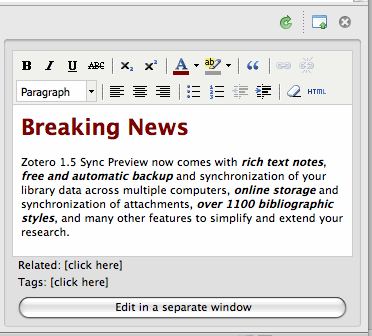
After nearly six months of extensive testing and tweaking, and with countless bug fixes done in progression with the movements of the Firefox 3 team, I’m pleased to report that the first version of Zotero that synchronizes with the much-awaited Zotero Server has been released for trial by the general public. Yes, you can now access your Zotero collection from anywhere and synchronize it across multiple machines (of any operating system). And of course the copy of your collection on our server means that you now have a free automatic backup of your Zotero library data.

[Long-time readers of this blog and my writing elsewhere know that this major update to Zotero was due some time ago; all I can say in my defense is that: 1) Firefox 3 was also supposed to be released last fall but finally was released at the end of June (and we needed Firefox 3 for the server versions of Zotero); 2) we've continued in the meantime to add dozens of new features and hundreds of new supported sites suggested in our forums to the "classic" version of Zotero; 3) synchronization of digital collections across multiple machines and our server is an outrageously difficult task (ask your local computer science guru); 4) we've also used the additional time to add functionality to Zotero 1.5 and subsequent versions that we believe will keep it far ahead of any commercial alternatives, and that will begin to enable Zotero's communication with the Internet Archive. OK, enough of the mea culpas. Let's get back to the exciting news.]

Although Zotero 1.5 maintains its easy-to-use iTunes-like interface, behind the scenes it includes a complex, robust communications and synchronization layer that provides the foundation for all subsequent releases of the software and our soon-to-come Zotero website and services, including public and private groups, collection sharing, and recommendations. This new layer also means that Zotero can begin to synchronize and link to other repositories, services, and applications on the Web. Although we have already gotten a lot of interest from outside software developers in creating extensions to Zotero, the new 1.5 will be another leap forward in allowing these developers to combine Zotero with whatever scholarly software or collections they are working on.

Other goodies we’ve thrown in (beyond this list of additions ported from 1.0) simply because we listen to our users and like to make them happy:

  • Even though Zotero has beaten Endnote in head-to-head competition, one point of comparison that some people thought Zotero was inferior on was its lack of the thousands of citation styles available on that commercial program. We still believe that the open source style system we have adopted, CSL (created by Bruce D’Arcus), is far more flexible and robust than the citation style systems of Endnote and other tools, and when you really look at the supposed “thousands of Endnote styles” they are really just many of copies of a limited number of styles with different journal names stuck on. Nevertheless we decided to make this point of comparison moot. Zotero users can now use Endnote styles as well as CSL styles, although we still plan to aggressively build out from the dozens of CSLs currently available and strongly encourage the creation and use of CSLs.
  • We have added preliminary support for ZeroConf. Let me translate the tech-speak: underneath the hood, Zotero now has the ability to broadcast collections over a local network, without going through the Zotero server. This means that a group of students in a classroom or academics at a conference can enable sharing and see and grab references or links from other users, much the same way that you can share your iTunes music library with others nearby. We plan to expand support for this feature in subsequent releases. (For now, it’s a bit hidden for testing.)

As always, when I use “we” in posts about Zotero, I mean our incredible team: the Center for History and New Media’s Director of Research Projects Sean Takats (who has succeeded me in that role), Lead Developer Dan Stillman, Connie Sehat (former CHNM senior staffer who has just been hired as Emory’s Director of Digital Scholarship), Zotero community liaison Trevor Owens, and the core developer team of Simon Kornblith, Jon Lesser, Michael Berkowitz, and Raymond Yee.

Why not take Zotero 1.5 for a spin (we include the normal caveats about beta software on our site, but in my experience it’s rather stable), extend it with plugins, or develop your own software for the Zotero platform?
Items of Interest for June 12, 2008

Thursday, June 12th, 2008

Somewhere in Second Life…

Wednesday, April 2nd, 2008

Zotero T-Shirt in SL, Front

Zotero T-Shirt in SL, Back

[thanks, Kari!]

Vertov Brings Video Annotation to Zotero

Tuesday, March 18th, 2008

From the beginning of the Zotero project, I’ve said that we have bigger fish to fry than citation management, although Zotero does that quite well, thank you very much. (Case in point: Zotero recently beat Endnote, RefWorks, and all of the other big citation managers in head-to-head competition at CiteFest.)

Zotero aims to be a digital research platform, and an extensible one at that. That’s why it’s gratifying and exciting to see the brilliant and incredibly useful Vertov plugin for Zotero. Vertov allows Zotero users to cut video and audio files into clips, annotate the clips, and integrate their annotations with other research sources and notes stored in Zotero. It has terrific functionality and should be ideal for use in the classroom as well as by film scholars and other researchers.

Vertov Screenshot

Congrats and many thanks to Concordia University’s Digital History Lab, led by Elena Razlogova, for conceptualizing and executing this great plugin.

PC Magazine Best Free Software IssueAnd since it’s been a little while since I’ve done shameless cheerleading for Zotero, it’s humbling to get the recognition from PC Magazine that Zotero has, for the second year in a row, been declared one of the best free software applications.

Washington Post on Zotero, Open Academia

Tuesday, January 1st, 2008

It was nice to see the Zotero project covered on the front page of the Washington Post yesterday in the article “Internet Access Is Only Prerequisite For More and More College Classes.” Also nice to see a quotation at the end of the article from yours truly about the movement in higher ed toward open tools and resources.

Two Misconceptions about the Zotero-IA Alliance

Friday, December 14th, 2007

Thanks to everyone for their helpful (and thankfully, mostly positive) feedback on the new Zotero-IA alliance. I wanted to try to clear up a couple of things that the press coverage and my own writing failed to communicate. (Note to self: finally get around to going to one of those media training courses so I can learn how to communicate all of the elements of a complex project well in three minutes, rather than lapsing into my natural academic long-windedness.)

1. Zotero + IA is not simply the Zotero Commons

Again, this is probably my fault for not communicating the breadth of the project better. The press has focused on items #1 and 2 in my original post—they are the easiest to explain—but while the project does indeed try to aggregate scholarly resources, it is also trying to solve another major problem with contemporary scholarship: scholars are increasingly using and citing web resources but have no easy way to point to stable URLs and cached web pages. In particular, I encourage everyone to read item #3 in my original post again, since I consider it extremely important to the project.

Items #4 and 5 also note that we are going to leverage IA for better collaboration, discovery, and recommendation systems. So yes, the Commons, but much more too.

2. Zotero + IA is not intended to put institutional repositories out of business, nor are they excluded from participation

There has been some hand-wringing in the library blogosphere this week (see, e.g., Library 2.0) that this project makes an end-run around institutional repositories. These worries were probably exacerbated by the initial press coverage that spoke of “bypassing” the libraries. However, I want to emphasize that this project does not make IA the exclusive back end for contributions. Indeed, I am aware of several libraries that are already experimenting with using Zotero as an input device for institutional repositories. There is already an API for the Zotero client that libraries can extract data and files from, and the server will have an even more powerful API so that libraries can (with their users’ permission, of course) save materials into an archive of their own.

Zotero and the Internet Archive Join Forces

Wednesday, December 12th, 2007

IA LogoZotero LogoI’m pleased to announce a major alliance between the Zotero project at the Center for History and New Media and the Internet Archive. It’s really a match made in heaven—a project to provide free and open source software and services for scholars joining together with the leading open library. The vision and support of the Andrew W. Mellon Foundation has made this possible, as they have made possible the major expansion of the Zotero project over the last year.

You will hear much more about this alliance in the coming months on this blog, but I wanted to outline five key elements of the project.

1. Exposing and Sharing the “Hidden Archive”

The Zotero-IA alliance will create a “Zotero Commons” into which scholarly materials can be added simply via the Zotero client. Almost every scholar and researcher has documents that they have scanned (some of which are in the public domain), finding aids they have created, or bibliographies on topics of interest. Currently there is no easy way to share these; giving them a central home at the Internet Archive will archive them permanently (before they are lost on personal hard drives) and make them broadly available to others.

We understand that not everyone will be willing to share everything (some may not be willing to share anything, even though almost every university commencement reminds graduates that they are joining a “community of scholars”), but we believe that the Commons will provide a good place for shareable materials to reside. The architectural historian with hundreds of photographs of buildings, the researcher who has scanned in old newspapers, and scholars who wish to publish materials in an open access environment will find this a helpful addition to Zotero and the Internet Archive. Some researchers may of course deposit materials only after finishing, say, a book project; what I have called “secondary scholarly materials” (e.g., bibliographies) will perhaps be more readily shared.

But we hope the second part of the project will further entice scholars to contribute important research materials to the Commons.

2. Searching the Personal Library

Most scholars have not yet figured out how to take full advantage of the digitized riches suddenly available on their computers. Indeed, the abundance of digital documents has actually exacerbated the problems of some researchers, who now find themselves overwhelmed by the sheer quantity of available material. Moreover, the major advantage of digital research—the ability to scan large masses of text quickly—is often unavailable to scholars who have done their own scanning or copying of texts.

A critical second part to this alliance of IA and Zotero is to bring robust and seamless Optical Character Recognition (OCR) to the vast majority of scholars who lack the means or do not know how to convert their scans into searchable text. In addition, this process will let others search through such newly digitized texts. After a submission to the Commons, the Internet Archive will subsequently return an OCRed version of each donated document to enable searchability. This text will be incorporated into the donor’s local index (on the Zotero client) and thus made searchable in Zotero’s powerful quick search and advanced search panes. In short, this process will provide a tremendous incentive for scholars to donate to the Commons, since it will help them with their own research.

3. Enabling Networked References and Annotations

One of the pillars of scholarship is the ability for distributed scholars to be sure they are referencing the same text or evidence. As noted in #1, one of the great advantages of the Zotero Commons at IA will be the transport of scholarly materials currently residing on personal hard drives to a public space with stable, rather than local, addresses. These addresses will become critical as scholars begin to use, refer to, and cite items in the Commons.

Yet the IA/Zotero partnership has another benefit: as scholars begin to use not only traditional primary sources that have been digitized but also “born digital” materials on the web (blogs, online essays, documents transcribed into HTML), the possibility arises for Zotero users to leverage the resources of IA to ensure a more reliable form of scholarly communication. One of the Internet Archive’s great strengths is that it has not only archived the web but also given each page a permanent URI that includes a time and date stamp in addition to the URL.

Currently when a scholar using Zotero wishes to save a web page for their research they simply store a local copy. For some, perhaps many, purposes this is fine. But for web documents that a scholar believes will be important to share, cite, or collaboratively annotate (e.g., among a group of coauthors of an article or book) we will provide a second option in the Zotero web save function to grab a permanent copy and URI from IA’s web archive. A scholar who shares this item in their library can then be sure that all others who choose to use it will be referring to the exact same document.

Moreover, unlike most research software the sophisticated annotation tools built into Zotero—the ability to highlight passages, add virtual Post-It notes, as well as regular notes on the overall document—maintain these annotations separately from the underlying document. This presents the exciting possibility for collaborative scholarly annotation of web pages.

4. Simplifying Collaborative Sharing

Groups of scholars also have the need to create more private “commons,” e.g., for documents that they would like to share in a limited way. In addition to the fully open Zotero Commons we will establish a mechanism for such restricted sharing. Via the Zotero Server, a user will be able to create a special collection with a distinct icon that shows up in the client interface (left column) for every member of the group.

Files added to these collections will be stored on the Internet Archive but will have restricted access. We believe that having these files reside on the IA server will encourage the donation of documents at the end of a collaborative project. The administrator of a shared collection will be able to move its contents into the fully open Zotero Commons via a single click in the administrative interface on the Zotero Server.

5. Facilitating Scholarly Discovery

The multiple libraries of content created by Zotero users and the multi-petabyte digital collections of the Internet Archive are resources that can potentially be of great use to the scholarly community. We believe that neither has experienced the level of exploration and usage we believe is possible through further development and collaboration.

The combined digital collections present opportunities for scholars to find primary research materials, to discover one another’s work, to identify materials that are already available in digital form and therefore do not need to be located and scanned, to find other scholars with similar interests and to share their own insights broadly. We plan to leverage the combined strengths of the Zotero project and the Internet Archive to work on better discovery tools.

Zotero Partners with Mozilla: Firefox Campus Edition

Tuesday, August 21st, 2007

Firefox Campus Edition logoIt’s been a very busy summer at the Center for History and New Media, and especially at the Zotero project. We had our own “Summer of Code,” our ranks swelling with fantastic interns and our code repository and site expanding from their efforts and the hard work of our core staff. In case you missed it, a major upgrade was released last week with many new features and improvements and support for countless new sites. (I’ll blog about several of the new features in the coming weeks, since they lay the foundation for new kinds of digital research.)

We have also been working on several major partnerships, one of which will launch tomorrow, August 22, 2007, when the Mozilla Corporation releases Firefox Campus Edition, which will ship with Zotero preinstalled.

Firefox Campus Edition Landing Page

It’s really exciting news for us, and should greatly expand the already large Zotero community. Firefox Campus Edition will be featured on the Mozilla home page and will be marketed to colleges and universities. It will be available for download at www.firefox.com/backtoschool when it launches.

But we’re just getting started. Watch the Zotero blog and this space for more major news and partnerships in the coming weeks and months.

Personal WorldCat Lists Now Zotero-Compatible

Thursday, July 5th, 2007

A great example of what I’ve been calling the “fluidity of bibliography.” WorldCat adds a feature that allows registered users to save and share lists of items they find in the WorldCat catalog. We tweak Zotero to work with it. Et voila–easy to find, save, share, grab, and re-share scholarly records.

Social and Semantic Computing for Historical Scholarship

Monday, May 14th, 2007

Under the assumption that many readers of this blog don’t receive the American Historical Association’s magazine Perspectives, you might be interested in this article I wrote for the May 2007 issue. In the piece I discuss the Zotero project’s connection to several recent trends in computing, and think ahead to what the Zotero server might mean for academic fields like history.